- It's easier to use pins if you distract your baby by giving them a toy or something to keep them occupied. This helps cut down on the squirm factor and then reduces the odds that they will yank the pin out of your hand as you fasten the diaper. They will think this is funny and you will likely end up with a puncture wound.
- If you store your pins in a bar of soap it helps decrease the grab of your pins as you pierce the diaper. You can also rub your needle on your scalp (See all those days without showering have a perk) and use the natural oils of your hair. You can see that I wrap my soap in a washcloth and fasten it with hairbands. You could tie it in a cloth bag too.
Friday, January 11, 2013
Pinning a Pre-fold
Friday, November 16, 2012
Cloth Diaper Info—Caring For Your Wool Diaper Covers
![]() |
| A Batch of Covers Ready to Wash |

Dissolve a small amount of lanolin (about a 1/4" bead per soaker,
or more for larger sizes or longies) in a cup with some hot water and wool wash
or a baby wash of your choice. You may also choose to use a lanolin enriched
wool wash.
If you cover has poopy residue on it (which is best wiped off
immediately with a damp cloth) gently clean it in warm water and maybe some lanolin soap without rubbing or
agitating it too much to prevent felting.
Fill a sink or tub with warm water and
submerge your wool cover in the water. Pour your soap and lanolin mixture over
the cover and gently stir the water with your hand to disperse the lanolin.
Turn your cover in the water to get it coated. Let the cover soak for 15
minutes. Drain the water out of the sink. Gently rinse the cover in warm water.
Then lay the cover on a clean dry towel and roll the towel
up to squeeze out the extra water. Then lay the cover out to dry on another
towel or over a drying rack. Do not hang heavier covers like longies over a single bar
to dry because the weight of the damp wool will cause the cover to stretch. If
you want the cover to dry more quickly, lay it outside in the shade on warm day
or place it in front of a fan.
If you have hand-knit longies or covers embellished with
ruffles, this is the time to do what is called blocking. While the cover is
damp on the towel, take the time to lay it out nicely and arrange any ruffles.
They will dry in the shape that you leave them. For ruffles, use your fingers
kind of like you are fluting a pie crust to puff up bell ruffles or to evenly
shape more free-flowing ruffles.
It’s hard to know before using a wool cover, but some wool
is more likely to get pills and fuzzies during wear. A few can be picked off by
hand, but if there are a lot, it will be tedious. I like to use a sweater
shaver to de-pill my covers. This can be done before or after washing and
drying. A sweater shaver costs around $10, or you could also use a sweater
stone as seen here. I prefer the shaver (even though it requires batteries)
because the stone tends to drag across some types of wool and pull. Lay the
cover flat and gently rub the shaver over the fuzzy areas in a circular motion.
Don’t go too fast, just let the shaver do its job, and when you are finished
your wool cover will look really revived.
It doesn’t take too much effort to keep your wool looking
nice and you can feel good about choosing a natural fiber with so many naturally good
qualities!
Friday, November 2, 2012
Out of Diapers? Try a Receiving Blanket!
I hope that your find this helpful! Happy cloth diapering :)
Friday, September 7, 2012
Cloth Diaper Information for Beginners
- What’s your budget
- Do you want high quality diapers, medium quality (this will affect your budget)
- Do you want only natural fibers in your diapering system, Mix or it doesn’t really matter
- Can you sew, do you think you could make diapers
- Do you want a really easy system so that anyone could use, do you want a mix of different systems (I recommend a mix)
Here are some of the different systems to choose from:
[youtube http://www.youtube.com/watch?v=R72mqYQ9XCA]
All In One diapers or AIO are diapers that are the simplest diapers for anyone to use. You don't have to stuff them and they are water proof. These diapers have to be washed after every use.
All In 2 Diapers (AI2) are a lot like AIO diapers The only difference is that the insert snaps in. The difference between the two is that The all in 2 dries faster since the insert can be unsnapped and put in the dryer while the shell hang dries. The AI2 can also have the insert removed and replaced with out having to wash the shell (as long as the shell is not soiled) You can do this a few times before you have to throw the shell in the wash.
Pocket Diapers are like all in one and all in in 2 mixed together. the insert is on the inside of the diaper like the AIO but it comes out via a pocket so like the All In 2 the insert can go in the drier while the shell hang dries. Like the AIO the pocket diaper has to be washed after every use.
Prefold Diapers are one of my favorite diapers they are your mothers cloth diaper but they are a classic. There are a few different folds. They are very versatile and I would say a must for every stash. Instead of using diaper pins they have snappies now which make changing time super easy especially if you have a wiggly baby! These diapers are not water proof and do require a cover. Next are
Fitted Diapers these are just like AIO in the sense of ease to put on baby but they are not water proof and do require a cover. They are great for night-time because the whole diaper is absorbent not just the insert.These diapers must be washed after every use. Last but not least are
Flat Diapers. Flat diapers are a single large layer of cloth that must be folded into the correct size to fit a baby. Flats must be pinned or you must use a snappi to stay on the baby, They require a cover to be waterproof. Flat diapers must be washed after each diaper change.
One Sized Diapers Can be an AIO, a pocket or a AI2 What makes it a one side is an adjustable rise to make the diaper very in size to fit baby as they grow.
Covers
Wool Covers (Longies and shorties) Wool fibers exteriors are hydrophobic (repel water) and the interior of the wool fiber is hygroscopic (attracts water); this makes a wool garment able to cover a wet diaper while inhibiting wicking, so outer garments remain dry. Wool felted and treated with lanolin is water resistant, air permeable, and slightly antibacterial, so it resists the buildup of odor. Some modern cloth diapers use felted wool fabric for covers, and there are several modern commercial knitting patterns for wool diaper covers. Longies and shorties don't have to have pants put over them. The longies and shorties are breathable and keep baby warm. These covers don't have to be washed offten unless they get soiled or start to stink. You must Lanolin them after every wash and they must be washed by hand and are delicate when wet.
PUL Cover. PUL stands for polyurethane laminated, While looking up info on PUL I think Celtic cloth describe it best so I will just quote them. "PUL is a lot more technical than just a plastic backing on fabric. The original application is the medical field, and it is still used for this purpose. Like cloth diapers, it is used to replace disposable products with reusable. It provides the waterproof barrier needed in the medical field that can survive multiple institutional washings. The laminate can also be autoclaved, which is a very high heat steam sterilization process, to make it safe for reuse even after it comes into contact with blood or other bodily fluids. The polyurethane laminate can be customized by the manufacturer and comes in different thicknesses. For cloth diapers, 1 mil or 2 mil is generally preferred. This allows for a good stretch, complete waterproofing, and is still comfortable enough to wear next to the skin. There are other options for waterproof fabric, but PUL is so durable and reliably waterproof it has become a favorite for cloth diapers. It has been truly kid tested! " This cover can be worn a few times before washing unless soiled. Fleece Covers are breathable like wool but are much less delecate, The have to be washed after every use but can be washed with diapers and put in the dryer.
Different diaper systems are all good for different goals. If your baby has a rash and you want to air her out without fear of her peeing on the floor or pooping on the towel you might choose a fitted , flat or a prefold. With or without a cover (wool and fleece only for that example) If you are traveling a long distance you might choose an AIO with suede cloth inner to keep baby dry or a pocket with a zorb insert. It all depends on the day to day situation.
Inserts
Pocket diapers are diapers that you stuff with an insert. Some AIO's have a pocket so you can add an insert for more absorbency. There are a few different types of Inserts.
Hemp is an all natural fiber that is very absorbent, Hemp fibers are longer, stronger, more absorbent, and more mildew-resistant than cotton. Making it possible for a trim fitting diaper with out sacrificing absorbency.
Microfiber is a synthetic material, you usually get this type of insert with your pockets and used for many AIOS in the internal soaker. They “quickly” absorb making them great for fast wetters and catching heavy wetters, overall on the absorbency scale not the most dense. Microfiber should not be placed directly against your baby’s skin. It is so absorbent that is can suck the moisture from babies skin, but underneath a flannel or fleece liner it is fine.
Zorb contains only tangled cellulose fibers from bamboo/cotton/viscose and poly micro fiber, the same fibers found in virtually every AIO diaper on the market – nothing else. These non-allergenic fibers are non-allergenic, durable and easy to sanitize We manufacture Zorb in the USA and Canadian in modern facilities that are safe & friendly for workers and the environment.Zorb is extremely fast at moving moisture around. Assaults are quickly spread over a wide area to minimize saturation and leak off in the area that is peed on. To see this drop a swatch into water, you will see the moisture moves instantly through the fabric. Zorb is considerably more resilient than fleeces and terrys, and way, way more resilient than microfiber toweling. When you squish it using the typical pressure of a baby (around 5psi), moisture simply moves to another part of the Zorb web. Natural fiber knits are slow to move moisture around, so pressure creates a leak off channel, polyester fleeces (micro and polar) and microfiber terry towels have weak webs that collapse under any pressure, they have the most trouble with leak off.
Thanks so much for reading my post and I hope that this information has helped you on your Big Cloth Adventure.
Leticia From Letjoy Cloth Diapers
Friday, July 6, 2012
Cloth Diapering Away From Home, Without Laundry Facilities
Here was our situation: Family trip (as in, us with DH’s parents and sibs). Cruise ship. No laundry facilities. (Obviously I did not choose the ship.) Genna was getting potty trained, but not usually away from home, and with a tendency to wait to tell us she needs to pee when she had approx. 8 seconds to get to the toilet.
We decided to take flat diapers, since they would wash the easiest and dry the fastest, not to mention that they pack so compactly. I also took several pairs of training pants because those would be easier on the travel days than trying to deal with a diaper and cover in the airplane bathroom. We also decided that we would throw away any poopy diapers, rather than trying to get them clean by hand washing in water of unknown temperature. (I wasn’t sure how hot the water on the boat would get.) I packed enough diapers for two days of full-time diapering, in addition to wipes and a few covers.
I hand-washed wet diapers and training pants in the sink in our bathroom – one at a time – every time we had one in need of washing. I rinsed them out under running cold water, then let them soak in hot soapy water for a few minutes before agitating with my hands for several minutes. I rinsed in hot water, then cold water, until I didn’t see any more bubbles. We hung them to dry using clothes pins and skirt hangers. The bathroom was too humid, so I actually hung them out on our cabin’s deck. Our cabin mates (my MIL, FIL, MIL’s aunt, and MIL’s friend) were not super impressed by this, but *shrug.*
There were a few days when we had oily soot from the ship’s smokestacks covering everything on the deck, and on those days, I hung diapers in the closet or in front of the window from the curtain rod. I brought clothesline, but was reluctant to just string it up somewhere.
This system worked well for us. Flats are not hard to wash by hand, they rinse clean fairly easily, and they dry fast. PUL covers are trim and also easy-care.
I used flats that I made from birdseye fabric, and we used some liquid laundry soap that I had sitting around the laundry room from our last trip last summer. It was probably Costco brand.
Yes, we could have just switched to disposables. but I didn’t want to. (And Genna got a horrible rash the one time she wore a disposable.) Had we been using disposables, I would have had to devote a lot more suitcase room to diapers, since I would have needed to pack enough to last the whole 12 days we were gone. And I would have had to worry about running out! And I’m honestly not sure what I would have done with them on the ship. They don’t have plastic liner bags in the garbage cans, and I wouldn’t have wanted to smell dirty disposable diapers all day, either.
As it turns out, using cloth was not a big deal. It didn’t take up much time. It was no more effort than using cloth at home. It was not a big deal.
Written by Sarah Reid, of Wallypop and Boulevard Designs
Friday, June 15, 2012
Cloth Diaper Tip: Wing Droop What It Is and How to Prevent It
There are a few reasons wing droop can happen. The first possible cause, and the most common, is that the diaper is too big for the baby. One Size diapers can have this reputation because One Size diapers are meant to fit on larger babies more easily and securely. One size diapers also rely on the fact that younger babies move less. However, some of us have little ones that decided crawling at 6 months or walking by 8 months is a great idea. Take my children, my oldest one didn’t walk until right around a year while my youngest walked right before 8 months which lead to us having more issues with wing droop.Avoiding OS diapers and buying only sized diapers could help solve some of the wing droop issues. Unfortunately, OS diapers, for most of us, are the most economical choice buying lots of sized diapers means buying more diapers in general which can get pretty pricey. On that same note, it is advisable to purchase more than one type of diaper as 29 Diapers Green Baby on a Budget strongly suggests. Its a great idea to have a mix of diapers to help you find which diapers work out the best for you and your little one. The great thing about having a variety is that sometimes as baby grows a diaper that worked great when they were 6 months might not work as well at 12 months and the diaper that didn’t fit a few months before fits great as they get older. Variety is also good for when different people are watching your little one and changing their diapers. I personally have always liked pockets the best while my husband thought changing AIOs was the easiest. Check out all the variety available from our Etsy Cloth Diaper Team!
Another cause of wing droop is simply that the diaper is being pulled too tightly. When there is back elastic you can easily pull the wings much further on the baby than it needs to be causing the wings to pull from where the diaper is snapped, typically in the middle. Let the back elastic do its job! It is there to help hold the diaper to the baby’s waist it doesn’t need to be pulled so tight. If gapping happens because it is Velcro (or even on Snaps) simply add a prefold diaper folded trifold style to help fill the diaper. By adding the prefold it should help eliminate the worry of leaks coming from the top.
A few other suggests are to make sure the wings connect straight across and not at an angle, meaning the back of the diaper is not sitting much higher on the baby. If the rise is too high use the fold down snaps to lower the rise or if that is not an option invest in a few cloth diaper safety pins. Not to mention get creative! Try arranging the snaps in different ways to get the best and most convenient fit. If that means creating some folds then by all means create some folds! Trial and error will be the best solution of wing droop. Here is a great little video (only a 1min and a half long) that shows how to be creative with the snaps! Good luck with tackling wing droop and hopefully you won’t abandon those diapers that have been giving you problems. Save some money and be green by being able to use all of your diapers. Happy Diapering.
*Picture from Cloth Diaper Shops Blog
Friday, May 4, 2012
ECing with cloth diapers
Disposable diaper companies these days spend lots of their marketing budgets convincing American families that their diapers keep babies the driest. And they use a lot of fancy chemicals to make sure that babies never feel wet when they pee. They've convinced Americans that this is the key to avoiding diaper rash.
Now, that lie aside, the important thing to consider for EC purposes is this: you don't want your baby feeling dry when they are wet.
You want your baby to feel when they are wet, so they can start to associate cause with effect, to know what wet feels like and what dry feels like, and to prefer dry over the slightly less comfortable wet. This is where cloth diapers excel.
(It's interesting to note that, before the use of "modern" cloth diapers with the microfleece stay-dry inner, babies in cloth diapers potty trained, on average, up to a year earlier than their disposable diapered peers.)
Practically speaking, how do you use cloth diapers as an EC backup? It's so easy.
I have not personally found that the type of diapers I use matters a whole lot with newborns, as long as they keep it easy for both me and the baby to tell when he is wet. (I personally prefer fitteds or prefolds without a cover for home, and we usually throw on a cover when we're out and about to keep the clothes dry.)
As your baby moves toward being able to give you about 3 seconds' advance warning that they're going to pee, you might find that you need to move to something that's faster to remove. Any type of diaper that closes with pins is probably a bad choice. Hook and loop tape is a better choice for quick removal, and leaving off covers when possible will let you know faster when you've had a miss.
Eventually, you'll reach that happy time of your child wanting to be an active participant in the potty process. At this point, you can move to something they can get on and off by themselves (like pull up training pants) or simply move to underwear.
Good luck!
If you're interested in learning more about Elimination Communication, please visit Wallypop or Diaper Free Baby.
Contributed by Sarah from Boulevard Designs and Wallypop.
Friday, February 17, 2012
Débutons les couches lavables!
Cela dépend de l'âge de votre enfant et de la fréquence des lavages. Voici le nombre de changement de couches quotidien en moyenne:
0-3 mois= 10 Ã 12
3-6 mois= 8 Ã 10
6 mois à la propreté= 6 à 8
Par contre, je ne vous conseille pas de mettre plus de 18 couches dans la laveuse pour assurer que les couches soient bien lavées. Il est toujours conseillé de ne pas trop chargée la laveuse.
Les types de couches:
Accompagnés de la traduction
Flat diaper = Couche plate
La couche plate est la fameuse couche que nos grands-mères utilisaient. Elle est très économique et dès rapidement. On peut même utiliser les fameuse petites couvertures de flannelle. Il suffit de les plier et ensuite de les fermer avec les épingles à couches, un snappi ou simplement refermer avec un couvre-couche imperméable à velcro. Personnellement, je trouve que c'est une couche facile d'utilisation sur les bébés de 0-3 mois. La couche demande un peu plus de doigté et est plus facile à mettre sur un bébé qui ne bouge pas trop.
Prefold diaper = Couche préformée
La couche préformée est semblable à la couche plate. La différence, c'est qu'elle est pré-plié en forme de rectangle et il y a un milieu absorbant. Elle s'utilise avec des épingles à couche, un snappi ou simplement avec un couvre-couche à velcro. Personnellement, c'est le type de couche que je préfère lorsque mes enfants étaient nouveau-né. Très économique, ça fait peur mais c'est assez simple d'utilisation et les couches sèches rapidement.
Contour diaper - Couche contour
C'est le même principe que la couche plate et préformé, à la seule différence qu'elle ne nécessite aucun pliage. Sèche rapidement, économique. À utiliser avec des épingles, un snappi ou un couvre-couche à velcro.
Fitted diaper = Couche moulée
Les couches moulées sont des couches de coton, bambou, chanvre ou zorb. Elle nécessite le port d'un couvre-couche. L'avantage de ces couches, c'est qu'elles sont très absorbantes. De plus, avec l'utilisation d'un couvre-couche, il y a moins de risques de fuites. Ce sont généralement des couches qui ont une durée de vie un peu plus grande.
Maintenant, voyons les couches qui ne nécessitent pas le port d'un couvre-couche:
AIO diaper - Couche Tout-en-un
Très simple d'utilisation, facile à mettre ... aussi facile qu'une jetable. Le noyau absorbant est cousu dans la couche, ne nécessite donc aucune préparation. Par contre, le temps de séchage est souvent long. C'est la couche préférée de papa et à la garderie.
AI2- Couche tout-en-deux
Simple d'utilisation mais demande un peu plus de préparation. Le noyau absorbant, l'insert est déposé (ou attaché avec un bouton-pression) sur la couche. La couche sèche alors rapidement. Avec certaine couche, il est possible de changer uniquement le noyau absorbant lorsque celui-ci est souillé.
Pocket diaper - Couche à poche
C'est une couche très populaire. Elle demande une préparation simple, il suffit de glisser l'insert dans la poche qui est situé à l'avant ou à l'arrière de la couche. C'est une couche idéal pour la garderie, elle est aussi simple qu'une couche jetable lorsqu'il est temps de l'utiliser. Un autre avantage, c'est que c'est une couche qui sèche rapidement puisque l'insert sera enlevé de la poche lors du lavage.
Pour finir, devais-je prendre des couches multi-tailles (plusieurs tailles) ou one-size c'est à dire à taille unique?
Encore une fois, je crois que ça dépends de vos besoins. Si vous comptez utiliser les couches lavables sur plusieurs enfants, l'achat de couches multi-tailles représentent une bonne option. Une couches à taille unique a une durée de vie d'environ 2 ans et demi ... dépendamment de votre roulement de lavage, bien entendu! Personnellement, je trouve que les couches à taille unique ne sont pas toujours bien adaptés aux nouveau-nés.
En conclusion, j'avoue avoir une préférence pour les couches moulées et les couches plates lorsques mes enfants ont de 0-3 mois. Ensuite, j'aime énormément les couches tout-en-deux, je n'aime pas les couches à poche (Mettre ma main dans une couche souillée, ce n'est vraiment pas ma tasse de thé) ... mais pour avoir des préférences, je me suis amusée à essayer différentes couches. Mon plus grand conseil est ... Éviter d'acheter 24 couches pareils et éviter ainsi la déception. Amusez-vous, essayez différents types de couches et différentes marques! :)
Julie de Créations JulyJoly
Friday, January 20, 2012
Making Your Own Diaper: Where to Buy Supplies
Celtic Cloths: I love their glossary of different diaper fabrics and how to use them. They carry PUL, Hemp, Bamboo, Suede Cloth, Organic Cotton, and notions such as FOE, Aplix, and size tags.
Natures Fabrics: They carry a very wide range of diaper making fabrics, but I particularly love all the different wool they have. They have the most extensive line I have seen.
Diaper Sewing Supplies: LOVE how extensive their PUL section is. I also love their wide variety of FOE colors, and Kam Snaps.
Babyville Boutique is the newest line from JoAnn Fabrics. There is a whole section in the store dedicated to diaper making. And they sell in small quantities, so if you are just starting out sewing your own diapers you can experiment and play around.
The Fabric Fairy: The have tons of cute prints on cotton knits, great for making fitted diapers. They even sell “diaper cuts."
Very Baby: Their most extensive selection is in the microfiber and terry section.
Wazoodle actually sells precut diaper making kits. This would be very helpful for a beginner. They also carry ProCare and Zorb fabrics, which are the latest “technological innovations” in diapering!
Friday, January 13, 2012
Paper or Plastic, Ma'am?
There's always a choice to make, and in the world of cloth diapers the choices are seemingly endless. Being a cloth diaper maker, my cloth diaper drawer is full of tester diapers made from every imaginable material and design. To show my appreciation to the kids for their willingness to change diapers, I always leave them the "easy" diapers to use. However, more and more these days I catch myself wanting to reach for those easy diapers. So what makes them easy? The hook and loop tape, of course! I know, it's the not-quite age-old question of velcro versus snaps (or neither). In my opinion, snaps and velcro win out over pins and Snappis, purely from an ease of use and convenience standpoint (there are other considerations). But we are talking about easy.So, why do I love hook and loop (also known as Velcro, Aplix, and Touchtape)? Here is a list of 3 things I love about hook and loop:
1) Completely Adjustable. You always get a perfect, snug fit. No matter which snap configuration I use, I never seem to get a perfect fit.
2) Super Fast! Two quick flicks of the hand, and that puppy is on. No wrestling with a twisty toddler while trying to fasten snaps.
3) Anyone who doesn't cloth diaper can figure it out. The grandparents, babysitter, neighbor, nursery worker, siblings--anyone can figure out velcro tabs!
Okay, now there are a few cons:
1) From a sewer's standpoint, my sewing machines really don't like sewing on hook tape. I have put several machines out of whack doing this. But if you are not sewing, you don't have to consider this.
2) Noisy. When they are tiny and you are still doing lots of midnight diaper changes, the ripping of the velcro could be a noisy disruption to a light sleeper that you are wanting to get right back to bed.
3) Laundry issues. Some people complain about laundry chains, but that is easily eliminated by using the laundry tabs that most hook and loop diapers come equipped with. Some CD users complain of fibers from disposable liners and wipes getting enmeshed in the hook tape. This can also be remedied by the use of the laundry tabs or by not washing disposable fibers with your diapers. And even if this does happen, as I have had happen, it doesn't really affect the function of the diaper.
There, I have stated my case. I think I will go sew up some hook and loop diapers using my newly purchased loop fabric and enjoy the ease! If you haven't tried hook and loop before and like the idea of easier diaper changes, many of our Etsy Cloth Diaper Team members sell hook and loop options in adorable prints and for affordable prices.
Your little guy is bound to get fired up about this handsome diaper by Mumtaz Soakers at: http://www.etsy.com/shop/MumtazSoakers
The lovely floral diaper at the top of this blog entry is sold by Honey Buns at: http://www.etsy.com/shop/honeybunsclothdiaper
Are you a die hard velcro or snaps mama? We'd love to hear why! That's one of the great things about modern cloth diapers--with all of the variety, there is bound to be one that's perfect for you. You just have to discover it.
Friday, December 16, 2011
Diaper Pail Liners
What do you DO with the dirty diapers?
The answer to that is a Diaper Pail Liner. Some people use empty trash cans, plastic grocery bags or small wet bags, but the pail liner is the easiest and most convenient ways to store the dirty diapers. Not only do they come in a plethora of colors, but diaper pail liners also help to reduce smells. And since they are reusable, they eliminate the additional waste created with the use of grocery and trash bags.
Made with PUL fabric, which stands for “polyurethane laminated,” these bags hold in wet diapers and their odors. They are waterproof in the sense that they will hold dampness and wet diapers without leaking, not in the sense of “they can hold 7 gallons of water.” Easy to use, our diaper pail liners have with an elastic cording, they easily stretch over the edge of a diaper pail or trash can.
Simply stretch the elastic cording over the edge of a trash can. Some people use conventional diaper pails for cloth diapers. Often times, diaper pail liners need to be custom ordered to fit these cans.
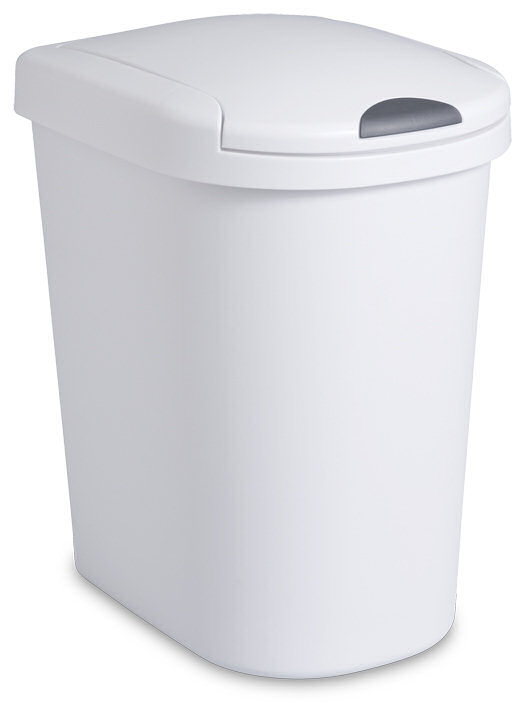
The other option for a diaper pail is a simple kitchen trash can. A lid is a major plus here. You can use a 13 gallon can or even smaller. We use a 7 gallon can, similar to this one: http://www.sterilite.com/SelectProduct.html?id=470&ProductCategory=210§ion=3
It is low profile, holds 20-24 diapers, fits right next to the toilet and doesn’t take over the powder room. Placing it here allows us to clean the diapers with a diaper sprayer and place them directly into the diaper pail. Our washing machine is adjacent to the powder room, so this makes for a quick and easy job. We do use a hanging wet bag upstairs to store the “dirties” in, but always bring them downstairs to the diaper pail before washing.
You can buy the pail liner or the diaper pail first, each way is fine. It can be easier to buy the pail liner first, and then take it with you to shop for a diaper pail or trash can. This eliminates hours of searching and waiting for a custom bag. Just remember to buy a trash can with a lid. It keeps the smells down.
How do you WASH a pail liner?
The other awesome use for 2 pail liners is travel. Yes, I said it. TRAVEL. We think nothing of traveling to Grandma’s house or getting on an airplane with cloth diapers. The hardest part for me is storing the abundance of clean AND dirty diapers in my car, at Grandma’s house or in my luggage. (Public Disclaimer: I only put clean diapers in the luggage – although I always laugh when I see an inspected tag on the suitcase with the diapers! Ha! Wonder what that poor TSA agent was thinking while looking at a bag of diapers!)
Diaper Pail Liners are indispensible in the cloth diapering world and can easily be found for under $20.00. For the benefits, it’s worth the investment.
Friday, November 25, 2011
Cloth Diapering with Special Needs or Circumstances
It wasn't until I was pregnant with my second son that I even entertained the thought of using cloth diapers. And it wasn't for any other reason than trying to save money on the cost of diapers. The thought of having two babies in diapers made my single income budget shudder in fear and despair. In retrospect, I'm so thankful for instinct leading me to cloth. You see, my Kili has some special circumstances that pose a diapering challenge. We have no technically named diagnosis, but we know that my almost 3 year old son has the large intestine the size of a grown man. He has no sensations of needing to eliminate, and there is no end in sight. He also has to be on large doses of laxatives to make sure he doesn't develope another blockage. It makes for a lot of poopy diapers, like 12 a day! That's a lot of waste when you're using disposables!! And it makes for a lot of dunking and swishing (don't worry, a diaper sprayer is on my Christmas wish list!) And he'll more than likely continue using diapers for the next 3-5 years.
Kilian isn't the only child with long term diapering needs. There are so many different challenges facing so many children and many of them will be in diapers for the entirety of their lives. Isn't it wonderful that we have an amazingly talented plethora of WAHM's that can design and create diapers for all ages and stages and needs?! And that as a WAHM we can help some of these children who already face challenges have healthier tushes while helping the environment and their parents already strapped pocket books at the same time?
I'll be forthright. When we first learned of Kilians challenges earlier this year, I balked at the thought of using cloth. I hated the thought of that many diaper changes (when in reality it is now less than it was then, 24 poopy diapers a day!), doing that much diaper laundry, essentially being changed to, well, changing diapers. But it's my reality. I have to change that many diapers a day (when you factor in how many his baby brother uses as well). And I have to change them regardless of them being cloth or disposables. But the converting incident was around my tenth diaper of the day (disposable) and finding my poor boy broken out in horrible blisters. In an hour, his skin deteriorated horribly because disposables just can't hold poop explosions like cloth can. And though we're in a better spot financially now than we were 3 years ago when I first decided to use cloth, throwing that much money away just pains me.
I can't speak for all the moms of special needs children. I don't know their stories and I would hate to tell it wrong. I'm just speaking from my heart on our situation and saying that cloth is possible even if you have a 3 year old poop monster, or a 5 year old bedwetter. Now we just need to find more WAHMS to fill the diapering needs of the special needs children.
Do you make big kid diapers, briefs for the older special needs person? There is a great need in the WAHM market for patterns and products geared towards our kids who face challenges. Do you know of another WAHM that does? Leave a comment, leave a link, and maybe some other mothers will be able to find what they need! Thanks ~ Dustie from Dustie Bottoms
Thursday, October 27, 2011
It is not impossible!
Many new moms who, for whatever reason, will work outside the home after their precious baby arrives may feel overwhelmed by the thought of motherhood altogether, much less the idea of using cloth diapers. For some, I'm guessing, cloth diapering is a fleeting thought followed by the comforting idea of the convenience of disposables. This was not the case for me! Especially not with baby #2.


.jpg)