Friday, October 21, 2011

Fall and winter woolies – a primer in buying wool and caring for it

While woolies are all-season clothing in our household, I contend that fall and winter is when we can go totally overboard with the woolies. It is truly the season for longies or even soakers with cute leggings! Choosing woolies can sometimes be overwhelming for a wool newbie, so here’s my primer on the different types of wool, and basics on how to wash, dry and lanolize your cloth diapering wool.

BASICS
: Wool makes an excellent cloth diaper cover – it’s breathable and thermal, keeps your baby comfortably warm while allowing the bum to breathe (reduces diaper rash). You can find wool cloth diaper covers in the “wrap” style (e.g. with snaps or Velcro closures), pull-on style covers (“soakers” – they look like wool underwear), or wool clothing that doubles as a cloth diaper cover (longies, shorties, skirties, etc). The basic types of wool include recycled (upcycled) wool, knitted or crocheted wool, and wool interlock. They are all wonderful (yes, I have tried it all!), and mostly it’s a matter of choosing something you like the look and feel of.

Recycled wool (upcycled wool) – woolies made from recycled sweaters. Often times, recycled wool is felted prior to cutting and sewing to give it a little more thickness (and pre-felted woolies can often be machine washed on cold/gentle when I’m lazy, which is happening more and more these days!). Recycled wool is typically the most economical type of wool, and is a great way to try wool without spending a lot. You can also find some really unique materials, such as luxury wool blends (wool/cashmere/angora) or beautiful stripes, argyle, and cable patterns. Recycled wool can vary in terms of wool content, thickness, and softness, so be sure to ask the maker if you have any questions!
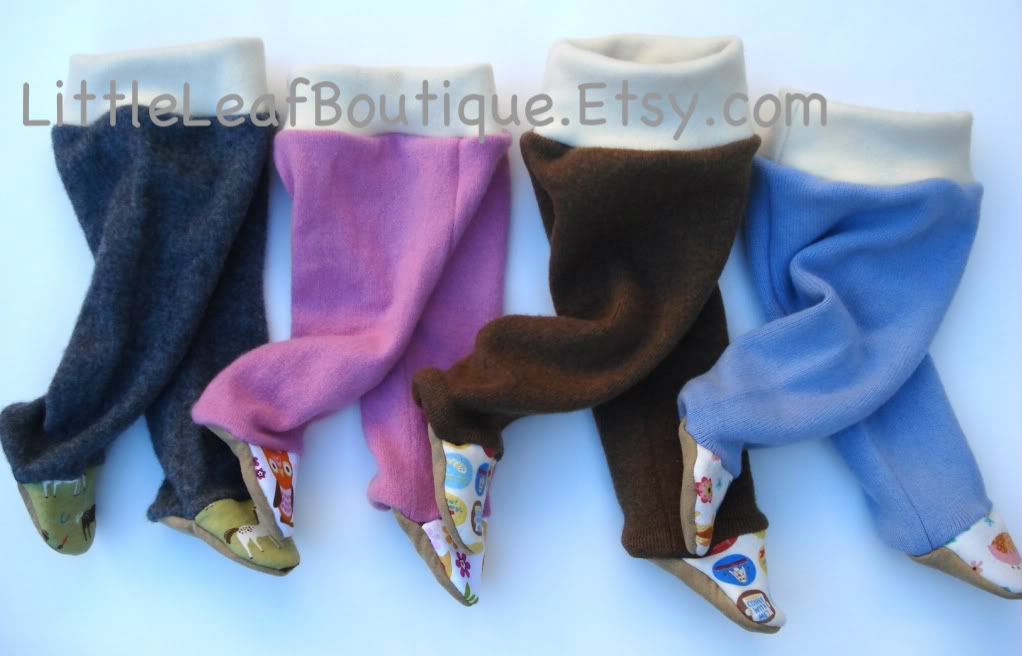

Knitted or crocheted wool
– woolies made from hand-knit or hand-crocheted yarn. Cloth diapering woolies are typically made from 100% wool yarn (some makers can use superwash wool yarn, but the superwash coating on the yarn makes it less effective as a moisture barrier). Wool yarns can be solid colors (which can be used to make stripes and monster faces, etc), or multi-colored (“variegated yarn”, and a specific color scheme is called a “colorway”). The pricing on knitted/crocheted woolies can vary widely, as a lot of it depends on the cost of yarn (there are some cheaper yarns, and then there are the more expensive hand-painted yarns), as well as the time involved in creating these woolies. Some knitted/crocheted woolies can be machine-washed on gentle (for the sturdier yarn bases – cestari, mountain meadow, blackberry ridge merino, etc), but most people recommend hand washing. The texture of the yarn can vary, so if you are a newbie, ask the maker about what the yarn feels like!

Wool interlock - this is a type of “interlocked” fabric that is typically pre-felted and then cut and sewn. Wool interlock is usually dyed solid colors, but I have seen some tie-dyed or LWI dyed varieties too. The wool interlock most often used for diapering woolies is blended with a small amount of Lycra to help it retain its stretch even after felting. Wool interlock can typically be machine-washed (the more felted ones can be machine washed on warm/regular, but it’s safest to wash on the gentle setting).

Washing your wool. Ok, so it’s probably obvious from the previous section that I do machine-wash a lot of my wool (at least, the recycled and interlock wool). I machine-wash with other clothes on warm/gentle or cold/gentle. If I’m feeling conscientious, I’ll throw it into a mesh lingerie bag.
How often do I wash?
Only when it gets dirty! For indoor woolies, I probably wash maybe once a month, and that’s with a messy toddler. For play woolies, I will wash more often, like every 1-2 wears (I stick with the machine-washable ones for play, but you can also hand wash play woolies too)
How often do I lanolize?
Maybe once every 6 weeks or so. I occasionally use a lanolin spray to keep it refreshed.

For hand-washing, here’s what I recommend:

1. Soak the woolie in tepid or warm water. Make sure it is fully wet.
2. Add wool wash (or use a wool wash bar and suds it in your hands, pressing the suds into the wool). Swish it around but don’t agitate like crazy. You can spot clean with the wool wash, too – really, it’s just like hand washing any other kind of fabric!
3. Soak 15 minutes, then squeeze out the water, spin out in washer, lay flat to dry.
If the wool is really dirty, I often rinse it out first, and then wash as normal.

For lanolizing (make sure your wool is clean first):
1. Turn your woolie inside-out. Soak your woolie in tepid water. Make sure it absorbs water completely.
2. In a separate container, take a dab of 100% pure lanolin, dissolved in hot water with a drop of wool wash (I use Eucalan) or baby shampoo. Dissolve it really well (mix or shake), then add this to a basin where your wool item is soaking.
3. Soak for 15-30 minutes. Squeeze out the water, roll in a towel (or spin in the washer) and lay flat to dry.

Have a wonderful wooly day!

Wednesday, October 19, 2011

Review and Giveaway of Boulevard Designs

Shop – Boulevard Designs
Twitter - @wallypop
Facebook - Wallypop and Boulevard Designs
Blog - wallypop.wordpress.com


Getting to know Sarah from Boulevard Designs:

How did you get started on Etsy? I had had my regular store, Wallypop, for several years when I started noticing more and more of the bloggers that I follow had opened shops on Etsy, and when I went to check it out, it seemed like something fun to try out. That was almost five years ago!


What makes your products unique? Most of my customers report that the fit of Wallypop/Boulevard Designs diapers is just amazing, which is always nice to hear. I also offer a fairly wide assortment of different things, from cloth diapers to upcycled baby shoes, to soap made with milk from my goat, Ginger.


Do you also sell your products locally in your community (craft fairs, consignment stores, etc)? Though I don't participate in craft fairs as much right now as I have in the past, my local sales are really strong, mostly through word of mouth. I have a small "store" in my office and see people by appointment if they want to come browse, or folks can shop online and come pick up their items when it's convenient.


What would somebody who is totally new to cloth diapering need to know about your product(s)? My products are sized for the best fit, and I typically use Touchtape closures. Touchtape is so strong and long-lasting, it's a much better product than what's used on mass-produced diapers. Don't be afraid of hook and loop tape just because you've had a bad experience with major brand diapers!


What advice would you give to people just starting out with cloth? Cloth diapers should not leak. Cloth diapers that do leak are having a problem which can usually be solved through answering a few simple

questions. Also, washing once a week is too infrequent. Every 2-3 days will keep stink down and help make sure your diapers last for years.


What is your inspiration or passion behind the type of product you make? I try to make diapers that are affordable to single income families, made from really sturdy materials, and easy to use. For the non-diapering products I offer, I really just look for other fun things I can make out of the materials I have on hand. After sewing diapers for 8 years, it's fun to take some time to sew up some adorable shoes, or to tie dye headscarves.


What is your favorite item you sell? I don't have any listed right now, but I love the geeky soaps I make. I get to share our awesome raw, organic goat milk with others (I'm not allowed to sell the milk for consumption), I get to share some other local ingredients like honey from a producer down the road, and I get to spread the geeky love. The baby shoes are another favorite for me. They're so unnecessary. Baby shoes are really kind of ridiculous when you think of it. But they're so adorable.


Giveaway Details

Sarah will be giving away a fleece cover of the winner's choice from either her Etsy store or her other store (which has more selection) www.wallypop.net


2 Required entries:

-Follow this blog, etsyclothdiapers.blogspot.com, via Google friend connect. If you are already a follower, just leave a comment saying you already follow. Otherwise, leave a comment saying you are a new follower.
-Visit Boulevard Designs' shop; come back here and leave a comment about your favorite item.

Additional optional entries (leave a separate comment for EACH of the following that apply)(be sure that you are signed in or leave a way to contact you in each comment):
- Like Boulevard Designs on Facebook

- Like the Etsy Cloth Diaper team on Facebook
- Follow the Etsy Cloth Diaper team on Twitter

- Tweet about the giveaway (limit one per day) - be sure to use @etsyclothdiaper in your tweet

-Post about the giveaway on your own blog.

Giveaway closes at 11:59pm EST on October 26th.

Winner will be announced on this blog on Thursday Oct. 27th.

A random blog comment number will be selected using random.org. You MUST comment on this blog post to be entered, and have contact info in your profile. Each entry entry must be its own comment. If you combine entries into one comment, it will only count as one entry. Winning entries will be validated, and you MUST do the required entry to have any additional entries be valid. Thank you for entering!

Monday, October 17, 2011

Meet the Team: Vilate from Nifty Nook

Today we will meet Vilate from Nifty Nappy Cloth Diapers. She has been selling on Etsy for 4 years. Her etsy shop is Vilate's Nifty Nook.

Vilate started cloth diapering to save money and started off sewing fitted cloth diapers for her two little girls. When her boy came along, she met another mom who used pocket diapers and fell in love with them. Vilate thought they would be cheaper to make them herself so she did!


Vilate makes make fitteds, AI2’s, swim diapers, trainers, Woolie Wraps, newborn diapers, and new born woolies. "It's been a fun adventure," says Vilate, describing her sewing experience. She experimented with different fabrics and patterns before sticking with a wool cover. She's also a big fan of organic fabrics like hemp and bamboo. Her hubby prefers front-snapping diapers so this is what she stuck with. Vilate's favourites include her fitteds and her woolie wraps.


The best cloth diapering advice Vilate received was to use tea tree oil in her diaper wash and to sun the diapers. Clean smelling diaper every time!


After making the perfect diaper and cover combination for her own children, Vilate felt she could offer these to other families. She began selling on Etsy and eventually created her own website. Vilate loves what she does: " I love the interaction I have with other mothers. I love that I can help them determine what is best for their families and live a greener lifestyle. If you think I can help you please feel free to ask any questions. I love to talk fluff and I would love to help you get started."

Sunday, October 16, 2011

Sneaky Vegetables


Wouldn’t it be great if everyone loved vegetables?  You could cook up a healthy dinner for your family without having to think twice.  Well, since I know that’s never going to happen I’ve come up with some creative ways to make sure everyone is eating their vegetables.

Spesto:
“spesto” is what I like to call regular old pesto with a hint of spinach (okay its more like half spinach but don’t tell my husband).   Here is the basic recipe but you can feel to add whatever you like.

½ cup fresh basil leaves
½ cup fresh spinach
4 cloves of garlic
¼ cup pine nuts
3 Tb spoons of olive oil

Put everything into a food processor and chop until well blended.  Toss it over pasta (whole wheat if you are feeling daring) and serve with some grated Parmesan cheese.

Sweet Sloppy Joe
Sloppy Joes are great “kid food” and the perfect way to disguise an extra serving of vegetables.  The key in this recipe is to chop the vegetables finely (I use a food processor). 

1 sweet potato roasted until soft
1 small onion finely chopped
1 red bell pepper finely chopped
1 stalk of celery finely chopped
1 lb. ground turkey (you can use beef but I prefer turkey)
2 tsp. chili powder
2 cups no-salt-added tomato puree
1 ½ tbsp. packed brown sugar
1 tbsp. cider vinegar
1 tbsp. Worcestershire sauce

Cook the ground meat, onions, pepper and celery in a large skillet with olive oil until meat is brown (no redness)
Scoop out the inside of the sweet potato and add to the meat along with the rest of the ingredients and simmer until the sauce thickens.  Serve over rolls (preferably whole wheat)

Now, don’t get me wrong, I don’t like lying.  I almost always fess up my “secret ingredients” it’s just easier to convince people after they’ve tried a bite or two.  
Happy Cooking!

Saturday, October 15, 2011

Healthy Happy Low Fat Banana Bread Recipe

Some time ago my husband was looking to bake a banana bread. In our household we try to eat healthy when and where we can,  avoiding highly processed foods and processed ingredients. We both love banana bread, and when my husband suggested that we make some we realized exactly how fattening and unhealthy a classic banana bread recipie is.

The same day my husband sought out and found a Low Fat Banana bread recipe that was "almost" there. He modified the indgredients but kept the simple recipe the way it was, hoping that perhaps we could create a well balanced,  healthy, low fat banana bread.

Well lo and behold! Not only did my husband find a nice low fat banana bread he certainly made it yummier. Simple to follow. Easy to make. Tasty to eat. I think you'll enjoy it. (I've noted hubby's mods down below where appropriate)

INGREDIENTS:


  • 2 large eggs - organic or non antibiotic,  grain fed works just great


  • 3/4 cup sugar - use brown sugar not white to keep things a little more real


  • 1 cup smashed ripe bananas (about 3 medium) - we use 4 -5 for some good banana richness


  • 1/3 cup buttermilk


  • 1 tablespoon vegetable oil - we don't put this in and leave everything up to the buttermilk


  • 1 tablespoon vanilla extract - try pure organic extract here


  • 1 3/4 cups all purpose flour - we use whole wheat flour here


  • 2 teaspoons baking powder


  • 1/2 teaspoon baking soda


  • 1/2 teaspoon salt - we don't add salt (why salt in a banana bread? never made sense to us.)


  • PREPARATION:

    Preheat oven to 325°F. Lightly grease 8 1/2x4 1/2x2 1/2-inch pan; dust with flour. Using electric mixer; beat eggs and sugar in large bowl until thick and light, about 5 minutes. Mix in smashed bananas, buttermilk, oil and vanilla. Sift flour, baking powder, baking soda and salt over mixture; beat until just blended. Transfer batter to prepared pan.
    Bake bread until golden brown on top and tester inserted into center comes out clean, about 1 hour. Turn bread out onto rack and cool.

    NOTES:

    My husband took the original recipie and modified it to give our family a little lift into our stepwise approach into a healthy food lifestyle. This cake is to DIE for. Rich in banana flavour, and very addictive. When he makes them I always ask him to make two because one doesn't last the day.

    I strongly suggest you try out his modifications. Why not bake one of each and see which one tastes better. I'm sure you'll agree that our healthy alternative is a tasty alternative.

    Happy baking!
    Related Posts Plugin for WordPress, Blogger...